In the evening, from our terrace, we can see bats flying out to feed. I was trying to photograph them with flash; in this photo I accidentally underexposed and also missed focus, but I like how it turned out.
Last month I wrote about a dove which nested on our balcony, and how I fortified her nest to avoid a casualty like the previous time she nested there.
The photo below is from just a day or two after her eggs hatched. Let's call it Day 2, though I'm not totally sure.
At the bottom-right corner of the photo, you can see a bit of the wire clothes-hanger which I added to support the nest. Coincidentally I just came across a video from Wild Taipei Film of a magpie which built its nest almost entirely from stolen hangers.
Also from Day 2, a few hours later:
Day 8, now the nest has only one bird:
This is a mystery to me, because at this stage I think the chicks were still too young to leave the nest. If one fell out, I'm pretty sure we would have seen it. And the nest is in a spot which is almost impossible for predators to reach.
Anyway, on Day 11, the remaining chick left the nest. For a while, it hopped around our balcony:
...then it took a few experimental leaps, and eventually flew to a nearby tree.
Now the mother dove appears to be hatching again, in the same nest.
Earlier this year, a pair of spotted doves nested in a corner of our balcony. The location was precarious, and their nest was rickety. Still, they somehow managed to lay eggs, which even hatched.
Unfortunately, that was while I was away; otherwise I would have tried to somehow reinforce the nest. One day there was a storm, and both chicks fell out of the nest and died.
Now the doves have nested again, in a different corner of the balcony. The new nest was equally precarious, but one day while the doves were away, I put a piece of cardboard under the nest, and further reinforced it with rope and a metal clothes-hanger. I hope they have better luck this time.
Edit: It seems dove nests are flimsy by design. There is even a subreddit called r/stupiddovenests.
We have a toy – no one seems to remember how we acquired it – which is a wooden box with a lid. When you slide it open, a snake pops out.
I don't have a pic of how it originally looked, but here are a couple of product photos from Amazon:
I recently painted our box. It now has a coiled snake on one side:
...and a mini snakes-and-ladders board on the other:
I used my recently-acquired set of acrylic markers which, despite being super cheap, are a delight to paint with.
I also painted another box and sent it to Tommy. It's a good gift for him because he's working on the snake-in-the-box problem in higher dimensions. His box has a coiled snake like mine, plus another snake traversing the edges of the box in a manner that respects the constraints of the problem.
When I went to the post office to mail it, they asked me what the box contains. I said it's a wooden toy, but in their customs form, they only had an "electronic toy" category – no "wooden toy" or even just "toy". A sign of the times! In the end, they filed it under "handicrafts".
Speaking of snakes, the other day at the Dhakuria Lakes, we saw an Oriental rat snake's unsuccessful attempt to hunt a rat. The snake climbed halfway up a tree and crept into a hollow in which the rat was hiding. But the rat jumped out just in time and scurried away, seemingly unharmed.
When visiting a new country, I like to read books set in that country – like A Room with a View before going to Florence, A Fez of the Heart before my Turkish holiday, and Independent People before visiting Iceland.
On a recent trip to Malaysia, I read The Night Tiger by Yangsze Choo – a novel set in the 1930s, when Malaysia (then called Malaya) was a British colony. I took this pic on my night flight to Kuala Lumpur.
I like when airplanes have this little folding table above the main table; it makes life easier for those of us who like to eat while reading. Yangsze Choo's author bio says she too "loves to eat and read (often at the same time)."
* * *
Soon after I moved to Singapore, I read an edited volume of essays called Eating Chilli Crab in the Anthropocene (for which, if I may brag, my friend Xiaoyun wrote the titular chapter). A subsequent chapter called 'Consuming Tigers' has this line which made a deep impression on me:
In 1930, the last wild tiger of Singapore was shot in Choa Chu Kang.
The story was reported in the Straits Times of October 27. Stuff like this is a powerful reminder of how quickly Singapore was transformed from an island which was mostly jungle, to the highly urbanised city-state that we see today.
* * *
Ng Xin, author of 'Consuming Tigers', says:
Since I began writing this chapter, I’ve started to notice tigers everywhere. They’re on beer cans and balm pots, on airplanes and bank facades, in the living room of Crazy Rich Asians and the Singapore state crest.
I had a similar experience after reading The Night Tiger, which features tigers as well as a character who may or may not be a weretiger.
Klang, which is near Kuala Lumpur, has some nice street art. This tiger is painted on a door, but the metal gate makes it look like it's in a cage.
I liked these tiles outside Cheah Kongsi, a temple in Penang:
...and I brought back this fridge magnet which now adorns my whiteboard:
* * *
In a previous post I wrote that I have a 19-inch monitor, but I recently got a 24.5-inch one (Acer EK251Q P6). The first film I watched on my new monitor was a documentary called Malaysia's Last Tigers.
It's on YouTube, but that version has a few minutes missing. You can watch the whole thing on Māori+ if you are in New Zealand (or use a VPN).
One of my favourite bits of the documentary is around 24:00 where they show footage of all the other animals which were captured by the National Tiger Survey's camera traps. They show lesser mouse deer, sunbear, wild dogs, binturong, yellow-throated marten, serow, pig-tailed macaques, Indian civet, crab-eating mongoose, Malayan tapir, Asian elephant, clouded leopard, marbled cat, leopard cat, golden cat, and my favourite, a black panther. And that's just the mammals.
Rainforests are really something.
My spring equinox post is a bit late this year.
A couple of years ago my friend Abbi installed a bird-feeder in her yard which has a solar-powered video camera. It streams the footage, so I (or anyone with login permission) can view the live feed, wherever in the world we might be. When the camera detects movement, it also uploads a video clip to the cloud, so we can view it after the event.
The photos below are stills from such clips. I enjoy seeing the yard at different times of the year, a bit like my Seasons posts of yore. Sometimes the camera gets activated by squirrels, chipmunks – and children, like at bottom right.

And one time, in the dead of night, it got activated by deer, resulting in some eerily magical footage.
A Malayan water monitor in Macritchie Reservoir, just before sunrise:
BTS phone pic by my friend:

Later in the walk (7:25 am, to be precise):

* * *
I've written before about songs which have what I call a subtle upping of the emotional stakes.
And then there are songs whose climax is not-so-subtle, or some might say, on-the-nose. One such song which I've been enjoying recently (sorry if this is too cheesy) is What It Sounds Like from the KPop Demon Hunters OST: My voice without the lies / This is what it sounds like.
I was picking saga seeds in a dry gutter when I found this female yellow-rumped flycatcher, curled up against some dead leaves and only moving feebly.
She had no obvious injury, but seemed very weak, or perhaps in a state of shock. I found her just outside my condo, so I picked her up and brought her in, put her in a cardboard box lined with towels, and gave her some water in a little plastic tray. She drank it, but only when I brought it very close to her – almost dipping her beak in it.
I then called ACRES, which is a wildlife rescue NGO. They said they had no capacity, and suggested contacting the National Parks hotline. In less than an hour, NParks sent someone to pick up the bird and take her to a vet where, I hope, she will make a full recovery.
While I waited for the NParks guy, I took some photos.
Two years ago (to the day!) I had a dream about taking photos of a wild bird in my apartment. I told my friend about it at the time, so I'll quote my texts verbatim:
Had a funny dream
A duck flew in through my bedroom window
Mallard duck. Male, because he had a green head
I quickly closed the window thinking I would interact with him for a bit
Then I had the idea that when I opened the balcony door to let him escape, I would take photos as he flies away. On burst mode, multiple frames per second. To see the flight/wing pattern
So I was standing by my bed, changing my lens to a zoom
Meanwhile the duck was chilling next to me. I patted his head
And then he was doing something on my hand with his beak. The thing that cats do – biting but not actually biting, more a show of affection
But then suddenly he bit me 😳 And again I could almost feel the serrations in the beak and pain in my hand. I probably even moved my hand in my sleep. And then I woke up.

The two photos were taken just a few minutes apart on Punggol beach, looking out across the Johor Strait (the lights on the right are from Malaysia). I used a 10 sec exposure for the first photo, and 1/250 sec for the second.
These are the first photos on this blog which were taken with my new Fuji X-E5 camera.
I wouldn't call myself a herper, but I do often go on nature walks where observing and photographing snakes is one of my main objectives. When I first got into it, my herper friends were a lot better at snake-spotting than I was, so I mainly relied on them. But with practice, I've gotten better at spotting them myself.
I recently took my friend's daughter on a night walk in Pasir Ris Park, and in three hours we spotted no fewer than seven snakes (four different species: Oriental whip snake, painted bronzeback, dog-faced water snake and crab-eating water snake).
The photos in this post are from solo walks earlier this week.
An elegant bronzeback at Thomson Nature Park:
...and a gorgeous Wagler's pit viper just off Old Upper Thomson Road:
Cropped to show a close-up of her eye, as well as the eponymous pit organ (the hollow just to the right of her eye) which allows pit vipers to "see" radiant heat:
The photos above were shot with a Laowa 65mm f/2.8 macro lens, which I got last year. This year I also got a Guage macro diffuser, which I use with on-camera flash. Good lighting makes such a difference!
The shot below was with a wide-angle lens – not a common choice for photographing snakes, but when your subject is cooperative as this viper was, it can produce striking results. I used a Sigma 10-18mm f/2.8 with Raynox DCR-250 macro converter.
Last year I posted about a tailless black cat I met at my friend's HDB block in Eunos. I had an instant connection with him, as you do with some cats (and also with some people).
A few months later, from a post on a Facebook group which cares for community cats, I found out that he died.
The photo is by Ruth Sn, posted with permission. Here's the note she wrote:
Just to inform the eunos feeders in case you are looking for the short tail black boy with glue on his back. For 3 days since Monday he was not well & stopped eating, aunt managed to secure him yesterday. I wanted to rush him to the vet in emergency but very sadly he passed away just before I reached her home
Remembering black gentle cute boy with big eyes. You are always untouchable but I managed to sayang you when your body lay lifeless.
You are always friendly to the other cats residing there giving them head rubs. Still missing you 😢😢😢
Sayang (from Malay) is a lovely word – especially the verb form, which means something like showing love and affection through sweet words or gestures.
It's been more than a year, but I still think about him from time to time. I'm glad that Ruth and the other auntie cared for him in his final days, and he got a sweet inter-faith (Christian–Buddhist) funeral and cremation. And I'm glad I got to meet him, however briefly, and sayang him, receiving many head rubs in exchange.
I see hornbills often enough, but somehow I never seem to have my camera on me, so in all this time I hadn't managed to get a good photo. This morning, one of these majestic birds came to perch on my bathroom window – so close that I didn't even need a camera. I took this photo with my phone:
I then ran to get my camera, and luckily he was still there, now perching on the rail outside my window – an even better location, with more light on his face.
Been a while since I posted, but you can always just decide that you're so back.
* * *
Years ago, when I visited Hyderabad as part of the Biryani Leg of my travels, I stayed with my friend Rao, who was nice enough to not just host me, but also show me around. He even took a day off work for a trip to Golconda Fort.
Rao said he hadn't been to the fort since he was as a kid, but he remembered a tree with a hollow in its trunk, so big that you could climb in. I was privately skeptical – many things seem bigger and more wondrous when we are kids, and revisiting them as adults can be disappointing.
But what do you know: the tree does exist, and is indeed big enough to climb into.
I later learned that it's a baobab, nicknamed Hathiyan ka Jhad (Elephant tree), and is over 400 years old. Baobabs are native to Africa, so this particular tree is believed to have been planted by Arab traders or wandering fakirs.
First we had to climb over the metal fence – Rao said it wasn't there when he visited as a kid – and then the tree itself.

...and then we climbed in. In the photo above, I'm sitting on the lip of the hollow, and in the one below, Rao has already climbed in. The hollow is even bigger than it looks from above – it widens out, and was big enough to accommodate us both.
* * *
Speaking of trees, there is a big one next to our pickleball court, which you can see in this post.
Tommy asked me what kind of tree it is. I wasn't sure, so I said I would check next time I went to play. Conversation from a couple of weeks later:
| me: | I went there a few times since you asked, but I keep forgetting to check. |
| Tommy: | The tree will still be there :) |
It's a rain tree, in case you were wondering.
* * *
I saw bioluminescent mushrooms again, this time on a night walk on the Mandai T15 trail. Unlike last time when I only had my phone, this time I had a camera:
We also saw a super cute moth. Unfortunately I didn't get a photo of the wings, so it's hard to identify the species.
The first colugo I ever saw in the wild was on a night walk in Bukit Batok Nature Park, led by my friend Xiaoyun.
Since then, I've seen several other colugos including this one, with a baby, in Lower Peirce Reservoir:
Lower Peirce Reservoir is also where I saw this female Wagler's pit viper, on a night walk with another friend, Kwang Ik.
A male Wagler's pit viper (they're much smaller than the females, and a different colour) was featured in a previous post.
Wagler's pit vipers are ambush predators, often staying in the same spot for days until they catch some prey. So I went back the next morning to get some daytime shots, and luckily she was still there.
Happy equinox, everyone!
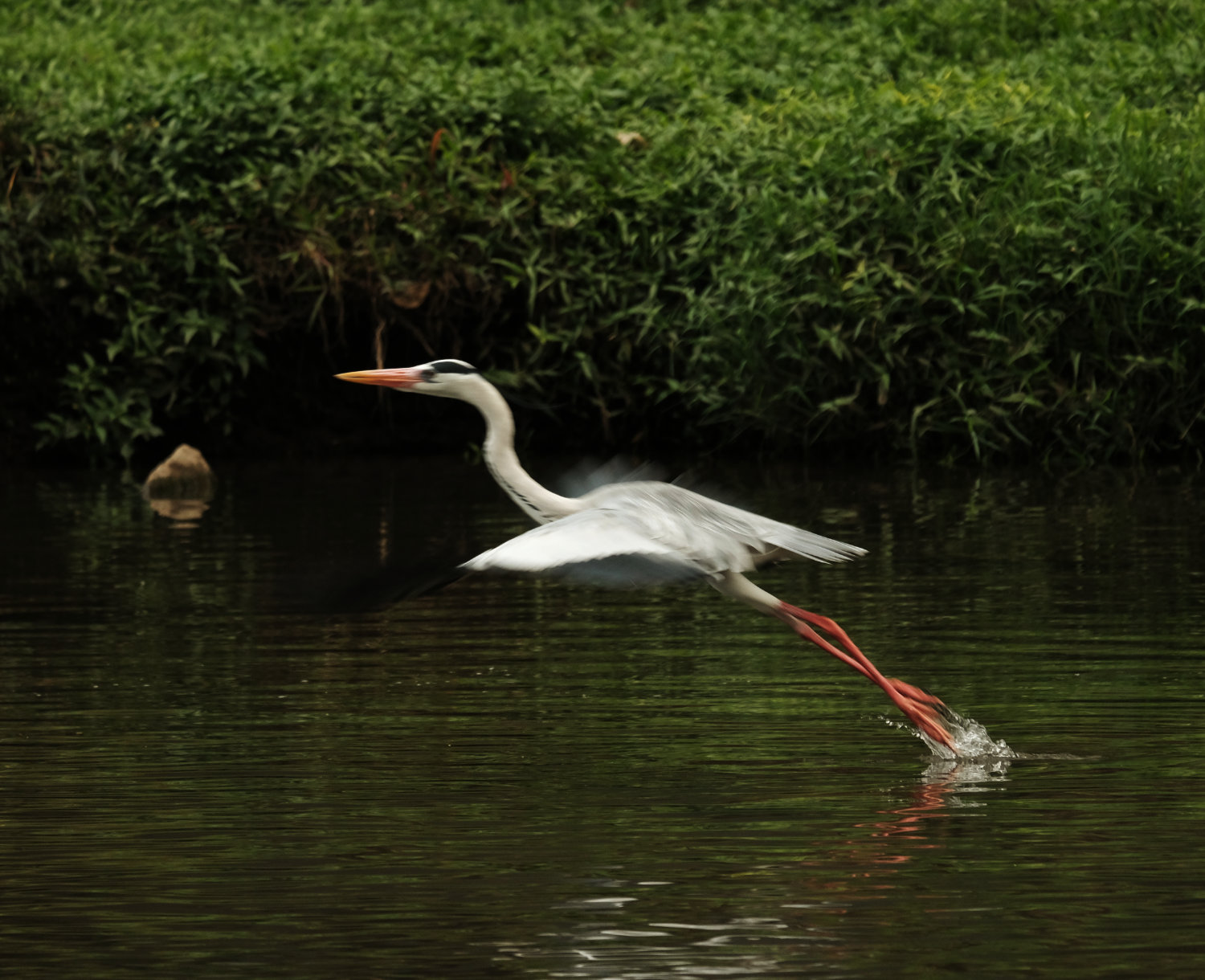
In Bishan Park the other day, I saw a grey heron standing in a stream. I was just thinking that if it took off, it would make for a good photo, and indeed the heron obliged, but alas, too promptly – before I had a chance to adjust my shutter speed. At 1/180 sec, there is enough motion blur that it's visibly unsharp, but not enough to look artistic. Oh well.
I saw some other piscivores including a stork-billed kingfisher (I took photos, but none good enough to be worth posting), other types of herons... and otters.
The otters and the heron were competing over the same stretch of water. I even managed to get them in the same frame.
I sent the photo to my friend, and that very same morning, she sent me a pic of a book that her daughter was reading (I Am Oliver the Otter by Pam Ayres, illustrated by Nicola O'Byrne):
Cloud Atlas by David Mitchell – one of my all-time favourite novels – has two scenes where people who are about to die relive happy memories. In the first, Sonmi-451, who is a fabricant (a type of clone) is giving her final interview. She is – spoiler alert – executed for rebellion, but in a post-apocalyptic future, she is revered as a god.
The interview has some zingers:
Archivist: But if you knew about this ... conspiracy, why did you cooperate with it?Sonmi-451: Why does any martyr cooperate with his judases? He sees a further endgame.
The interview, and the chapter, ends with her final request:
You can switch off your silver orison now, Archivist. My time is short and I claim my last request.Very well... name it.The use of your sony and access codes.What do you wish to download?I wish to finish viewing a film I began watching when, for an hour in my life, I knew happiness.
Cloud Atlas consists of six nested stories spanning multiple geographies and timelines. In San Francisco, 1973, Joe Napier, a security man, wants to retire to his mountain cabin and a life of fishing. But he tries to help his friend's daughter, journalist Luisa Rey, in a corporate crime investigation, and eventually dies trying to protect her. He is shot by Bill Smoke, a henchman, who leaves Napier for dead, and turns his attention to Luisa Rey. But Napier summons the last of his strength, and reaches for his gun:
The trigger resists his index finger – then a blaze of incredible noise spins Bill Smoke backwards, his arms flailing like a marionette's.In the fourth to last moment of his life, Napier fires another bullet into the marionette silhouetted by stars. The word 'Silvaplana' comes to him, unasked for.In the third to last moment, Bill Smoke’s body slides down the cabin door.Second to last, an inset digital clock blinks from 21:57 to 21:58.Napier's eyes sink, newborn sunshine slants through ancient oaks and dances on a lost river. Look, Joe, herons.
I've occasionally thought about what my final moments – and final thoughts – might be like. Whether I'll be alone or have people around me. Whether I'll be conscious of the fact that my time is up. And if I'm conscious, whether I'll want to be fully present in the moment, or perhaps, drift off as I relive a happy memory.
I'll ponder some more, and write about it in my next post.
And I'll try not to die before that – which would be ironic, but also one hell of a cliffhanger.
I took this photo a couple of years ago in our backyard in Kolkata:
They look different but I'm pretty sure they are the same species: oriental garden lizard, also known as changeable lizard because they can change colour. Wikipedia says:
The ground-colour is generally a light brownish olive, but the lizard can change it to bright red, to black, and to a mixture of both. This change is sometimes confined to the head, at other times diffused over the whole body and tail.
Sometime back I posted phone pics of an electric blue jumping spider, and said "someday I hope to get a good macro shot of one of these beauties".
Since then I've been carrying my camera more frequently when I go for walks in the Botanic Gardens, and keeping an eye out for spiders – and you really do need to keep an eye out, because these guys are tiny!
Besides the electric blue jumping spider (Phintella vittata) that I saw earlier, there are at least two other species with a jewel-like blue-green carapace (this post was very helpful for identification).
1. Cosmophasis thalassina (sea green jumping spider)
With their big round eyes, jumping spiders are incredibly cute and photogenic. Wikipedia describes them in more sedate terms:
the large anterior eyes of Salticidae are adapted to detailed, three-dimensional vision for purposes of estimating the range, direction, and nature of potential prey, permitting the spider to direct its attacking leaps with great precision.

2. Cosmophasis umbratica (shiny jumping spider)
3. Phintella vittata (electric blue jumping spider)
Another reason I love jumping spiders is because they are so curious, often gazing up at me and my camera – perhaps sizing us up as potential prey – and even jumping onto my bag (as in the photo above) or my arm (below). That's my forearm hair, in case you needed a reminder of how tiny they are.