Showing posts with label Law firms. Show all posts

Tuesday, 2 January 2018

Leisure Deficit

“I seem to have banged on this year rather more than usual,” observes Alan Bennett in his latest collection of diaries, Keeping On Keeping On.
I came across this line in a book review I read last week and thought well, this is certainly not something I can say about myself. In 2017 I wrote fewer blogposts than any other year since this blog began.

Since I started my PhD in 2014, I have a little more free time than I did when I worked in a law firm. Funnily enough, this free time seems more 'crowded' than before. For some time I've been pondering why this is so, and I now have a theory which is as follows:

Let's say I have F hours of free time per day. Of that, I tend to spend some part (P) coming up with new projects (say P = F/8). The free time I would need to properly pursue all these projects (F*) is a function of P (say F* = 12P). F* − F is my leisure deficit: the gap between the free time I want and the free time I have. (At this point, you might pause to remark that I have a depressing habit of treating leisure like a resource to be exploited for maximum yield. You would be right.) Anyhow, for the (admittedly speculative and simplistic) values I used above, the leisure deficit turns out to be F/2. Which is to say, the more free time I have, the greater my leisure deficit.

Suppose as a finance lawyer, I had an average of 2 hours of free time on weekdays. Then F* (the free time needed) was 3 hours. Now I may have, say, 4 hours of free time, but F* is 6 hours, and the leisure deficit is 2 hours: twice as much as before. As with anything else, it's easier to see graphically:


I was thinking about a new year's resolution to spend more time working on my existing projects and less time coming up with new ones (my Japanese teacher once told me, in a periodic performance review, that one of my weaknesses is that I have too many hobbies). But I could also just make my peace with having some unfinished projects. In one of his essays, Montaigne, a kind of proto-blogger, wrote, "Let death take me planting my cabbages, indifferent to him and still more to my unfinished garden." Though it is not clear from the quote if Montaigne, like me, was wont to leaving projects unfinished simply because he got distracted by a new project; death is a more watertight excuse.

What fate awaits these unfinished projects? Some bide their time in cupboards, like the papier-mâché fruit-bowl which I made but still haven't painted. Others have only an incorporeal existence in my bookmarks folder. These include my abandoned attempts to learn Russian (Languages folder) and meditate every day (Psychology and meditation folder).

In case you're wondering, the parent folder is called Fitness because it started life as a collection of webpages on workouts and fitness plans. Later I subsumed some other folders under Fitness to keep things organised, and on the basis that they too promote a kind of fitness – mental fitness, if you will. The original bookmarks now live in the folder called Actual fitness. Or perhaps I should have called it: Fitness fitness.

Thankfully, some of the projects in the folder are still very much alive, like Knitting, which I learnt to do last month. Others, like this blog, are active, but get less attention than they deserve.


Edit: Since writing this post, I found out that the Swedish economist Staffan Linder also used the phrase 'leisure deficit' though, I believe, in a slightly different context. I will read his book later this month and update this note.

Saturday, 28 February 2015

Seasons 4: Canary Wharf, London

Move your cursor over the image below, and it should change to another image of the same scene in a different season. (If it doesn't work, check that your browser has JavaScript enabled.)


Base photo:23 July 2014
Mouseover photo:27 February 2015
Approx. coordinates:51.50°N, 0.02°W

The trees in the foreground are dawn redwoods in Jubilee Park – an island of greenery amidst the skyscrapers of Canary Wharf. The dawn redwood is a fascinating tree. It was believed to be extinct and known only from ancient fossils, until a small stand was "discovered" in 1944 in the forests of Central China. (I put "discovered" because the tree was well-known to local villagers, without whose the help the botanists may never have discovered it.) The tree's morphology has not changed for 65 million years, which means that the trees in Jubilee Park are essentially identical to those in Cretaceous-period forests, when Tyrannosaurus roamed the earth.

The dawn redwood is also one of a very few conifers which shed their leaves in autumn. If it were evergreen, as most conifers are, the two photos above would have looked very similar.

The building in the background belongs to a law firm where I worked for four years.

Friday, 12 September 2014

Easily Alarmed

This week London hosted the Tall Ships Festival, which transformed the stretch of river that runs past my flat, making ordinary photos (like the one below) look like Canaletto paintings.


It also prompted the Head of Facilities Management at my law firm to send this email to everyone in the London office:
At 11:30 hrs today a cannon will be fired by one of the ships docking at Wood Wharf as part of the Tall Ships Festival taking place there over the weekend. Please do not be concerned should you hear this.

Friday, 16 May 2014

Legal Jargon

The Gherkin in London was recently put into receivership, and predictably, newspapers had a field day with headline puns (financial pickle, salad days over, etc.)

Last week the High Court delivered a judgment on the interpretation of the loan facility agreement used to finance the purchase of the Gherkin. Justice Flaux mercifully steered clear of gherkin puns, but slipped in a sentence which brings some hope to me and others in my line of work who have, late at night, sweated over a seemingly incomprehensible clause in a facility agreement:
In lengthy commercial contracts of this kind there will often be words or phrases which are surplusage or which have no obvious meaning. [emphasis supplied]
To give credit where it's due, the law firm where I work discourages the use of jargon in drafting. When I was a trainee, we were told, "The only excuse for using Latin in a memo to a client is if your client is an ancient Roman."

Wednesday, 12 March 2014

Earthquake Memories


Tuesday, 8 March 2011, was the first day of my six-month secondment to my law firm's office in Tokyo. Upon arrival, I got a health-and-safety briefing which, among other things, introduced me to the earthquake pack under my desk. It had a hard hat, fire-blanket, rope, torch, whistle, bottled water, tinned food and biscuits. The biscuits interested me particularly. They were not very tasty, but when I ate a few and then drank some water, I felt as full as if I had eaten a big meal.

On Wednesday morning, there was a 7.2-magnitude quake off the coast of Japan, and the high-rise building I was in swayed noticeably. I was thrilled to be in my first real earthquake, but after that I left the biscuits alone.

Later that day I had a Japanese lesson. Among the first words my teacher taught me were emergency words, "just in case": 地震 (jishin: earthquake), 火 (hi: fire) and 火山 (kazan: volcano). "And of course, tsunami is already a word in English," she said.

On Friday afternoon there was a 9.0: one of the most powerful earthquakes in recorded history.

The alerts began to sound seconds before the tremors began. The recorded announcements were in Japanese, followed by English. My supervisor translated the Japanese announcements as they sounded, giving me a few seconds' advantage. The first one told us to put on our hard hats. The second one told us to get under our desks. It was not yet necessary to evacuate; we were actually safer in the earthquake-resistant building than in the street outside, where we might be endangered by falling objects.

When the tremors subsided, we were told to keep our hard hats on because there might be aftershocks. The Japanese people seemed composed; they went around switching off the air-conditioners because they said after an earthquake that size, some power stations had probably switched off. Some of the expats were freaking out, but I remember feeling excited rather than fearful or panicky (news from Fukushima was yet to filter through, so we had not realised the scale of the disaster). Rather than adding to the uproar, I went back to work. My supervisor was so amused that she took a photo on her phone.


Out of the whole episode, what impressed me most was Japan's disaster preparedness and recovery (at least so far as the earthquake is concerned; the Japan government's reaction to the Fukushima meltdown has perhaps not been beyond reproach). The earthquake registered an upper five in Tokyo, but there was little damage to property because the buildings, like in the parable of the Oak and the Reed, are designed to sway with the tremors rather than stiffly resist. In my flat, picture frames were askew and a few books fell off the shelves. The Tōkaidō Shinkansen resumed limited service late in the day, and the next day it was back to its normal schedule. By next week, my hotel was issuing notices about bicycle parking.

Friday, 16 August 2013

Dashy Writing

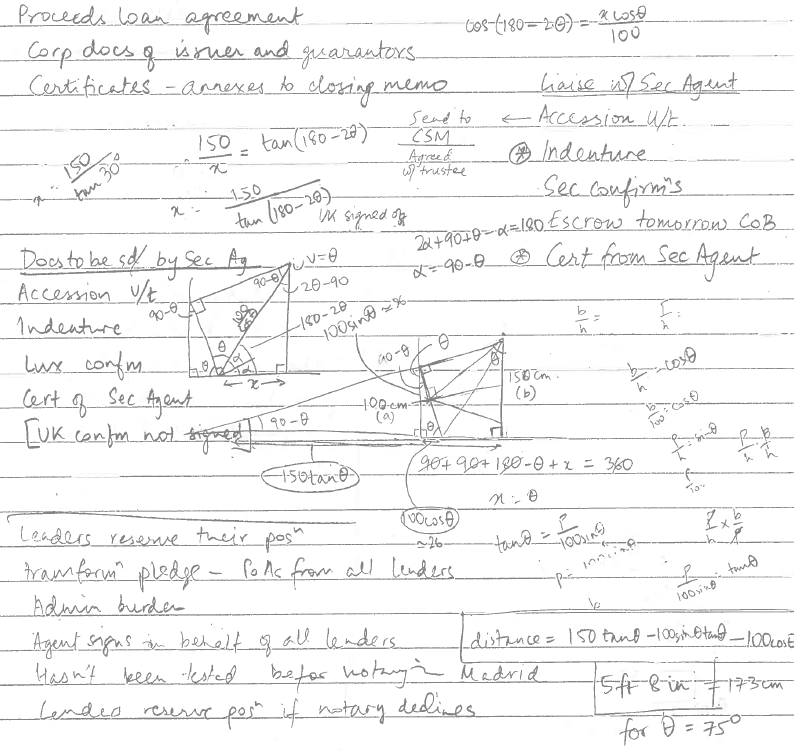
My work notebook is quite organised (once I left it in a partner's office and she returned it to me, saying she guessed it was mine because of all the tables and numbered lists). But sometimes I retrospectively clutter the pages with doodles or recreational maths. Here is a page where I worked on a practical problem of geometrical optics.
 

Unfortunately, my handwriting in my work notebook tends to be slipshod. I suspect it is not quite at the stage where, as suggested in the early 20th century Lessons in Dashy Writing, it can be a promising ladder by which I rise in the world.
 

Tuesday, 29 January 2013

Dream Tricycle

I got to work early this morning, so once I had finished filing yesterday’s emails and making my to-do list for the day, it was doodle-time.

2 months and 13 days ago, I had a (very pleasant) dream involving a curious vehicle – an old-fashioned penny-farthing, but with two rear wheels. Passengers could stand on the rear axle, but had to backpedal constantly, as one does on a rolling log, to avoid falling off.

My work notebook is filled with sketches of this contraption drawn from various angles, some more detailed than others. Here is a sample.


The black cat did not feature in the dream, and is in the drawing only to show scale.

Wednesday, 19 December 2012

Law Firm Toilet Humour

In moot court competitions at college, the court clerk would hold up sheets of paper saying 5 MINUTES LEFT or 1 MINUTE LEFT in large bold letters, so that the speaker would know how much time they had. One time, after our college hosted a moot court competition, someone (perhaps the same miscreant who was behind the Mystery of the Locked Loos) pasted these sheets at eye level on the inside of the loo doors in our hostel. I thought it was a sobering reminder not only of our limited time in the loo (there were 6 loos on our floor and 48 boys, all of whom wanted to use the toilet at the same time, i.e. 5 minutes before class, which meant that no one could occupy the toilet for more than a few minutes without attracting copious abuse), but also of our finite lives in this mortal coil.

Today in the office toilet I saw another witty use of stickers meant for other purposes. CONFIDENTIAL WASTE stickers are not hard to come by in a law firm, and someone had had the bright idea of sticking one at a strategic spot on the toilet wall.

Friday, 28 September 2012

Search Results

Existential messages generated by a computer are always funny, and this post reminded me of one of my favourites. I am no fan of Microsoft Outlook, but I love the question which appears below a search result.

Saturday, 11 February 2012

Non-Performance

My supervisor, explaining a deal to me:
“So these guys are trying to sell off an NPL portfolio.”
“What’s NPL?” (momentarily baffled because my first association with NPL is to something else)
“Non-performing loans. They acquired these NPLs and now they’re trying to sell them off, but they’re taking a loss because the yield has been low.”
“Low relative even to expectations at the time when they were acquired?”
“Yes. They’re non-performing non-performing loans.”

Friday, 3 February 2012

Thursday, 15 December 2011

Three Languages

Thai

It was my supervisor who told me about a Thai tongue-twister which, when transliterated, reads mai mai mai mai mai, but which in fact consists of five distinct words pronounced in different tones. Apparently it means ‘New wood doesn’t burn, does it?’

And this naturally led us to consider the possibility of an entire language consisting of a single syllable spoken in an infinitude of tones and registers.

I think our conclusion was that whatever other attractions such a language may have, we wouldn’t fancy using it to draft an intercreditor agreement.

Finnish

I read a novel recently, with the improbable title of A New Finnish Grammar. I will now proceed to quote from it liberally, because it is not everyday that you find an author who writes so passionately about language.

On the noun:

In the Finnish language the noun is hard to lay hands on, hidden as it is behind the endless declensions of its fifteen cases and only rarely caught unawares in the nominative.
On memorising words:
With some difficulty, one by one, I was taking in Koskela’s words. In the pauses between them, I heard them die away. I watched them floating down into the landscape of the city around us, so as to note where they fell, so that I could go and collect them later: a belltower would remind me of a verb, I wasted a whole ship on an adjective and entrusted the all-important subject to a tram. The pastor’s thought was scattered throughout Helsinki, and I could reread it every time I pleased.
On obsessive practice:
I would shut myself in the sacristy and study every word I’d put down in the notebook, declining it in all possible cases, conjugating each verb in every voice I knew, down to the most tortuous forms of the passive, the conditional, even the past potential. [...] Those syntactical digests were my defence against an enemy who was attacking me from behind. I had no tanks, no bombardiers, and each day surprised me on a different front, drawing me into the open, far from reason’s hiding-places, towards a chasm of gloomy, giddy thoughts. It was then that I needed all fifteen Finnish grammatical cases, the four forms of the infinitive, not to mention the negative pluperfect to keep my mind engaged, to drag it clear of that carpet bombing.

Beautiful, no?

Japanese

I learnt the word naruhodo on a snorkelling trip in Japan.

I had taken an underwater photo of a Japanese colleague, and I was quite pleased with the result. Back on the beach I showed her the photo. She said, “Naruhodo.”

Now at the time I did not know what the expression meant, and I was too vain to ask her. But I assumed it meant, “This photograph overwhelms me. Your talent makes me go weak in the knees, and I love you with a passion that is inextinguishable.” For it really was a pretty good photo.

When I went home, I checked. Naruhodo means ‘I see.’

Saturday, 15 October 2011

For Poor People

I was filing emails at work yesterday when I found this:

At first I thought it was just another email to cheer up people who are working late. But 11 March 2011 was the day of the Tōhoku earthquake. Many people, that is, even more than usual, were stuck in office because the trains were down.

Thursday, 22 September 2011

Life in General

The weekends pass really quickly, but then the weekdays pass quickly too, so I don’t complain. Look, it’s almost Friday!

Saturday, 10 September 2011

London, 8:20 pm

Working late is seldom fun, but I am sometimes thankful for the nice view from my window.

Or to paraphrase an earlier post: he doesn’t have a very exciting life, but he does have an office with a view.

Saturday, 9 April 2011

Karaoke

Thirteen finance lawyers – seven of them Japanese, two English guys, two Singaporeans, a Chinese girl and me – after work on a Friday night (or more accurately, Saturday morning), in a Karaoke Box in downtown Tokyo. And which is the one song that everyone knows?

Hey Jude? Knocking on Heaven’s Door? Smells Like Teen Spirit? A seminal moment in musical history, an evergreen classic?

The answer is simpler and funnier: Backstreet Boys. I Want It That Way.

Thursday, 10 March 2011

Eventful Days

There has seldom been a dull moment since I touched down in Tokyo. On Monday it snowed, taking everyone by surprise. Tuesday was my first day at work in the Tokyo office. Around lunchtime on Wednesday there was an earthquake. This occasioned much less surprise than the snow. And today, on the walls of Tameike-Sannō underground station, I saw what could only be a depiction of – of all things – the Taj Mahal.

Wednesday, 2 March 2011

Wednesday: Extract 3

Extract 3 is from Work Document:
Although financial markets have shown some degree of stabilization and economic recovery has continued in 2010, the recovery has been fragile and uncertainty about future developments of the market remains.
—Base Prospectus for a €30bn EMTN Programme
This is the third of seven posts in the Extracts series. In the comments section you can, if you want, post extracts from what you have read/heard today.

Wednesday, 23 February 2011

Work Visa

Tourist visas are fundamentally cooler than work visas. A work visa declares that you are a wage-slave, while a tourist visa says that you are – not to put too fine a point on it – a tourist.

Having said that, descriptions on work visas are generally quite flattering. Mine, for instance, is a UK Tier 2 work visa, which means that I am “a skilled worker who fills a gap in the workforce that cannot be filled by a settled worker.”

But I got a Japan work visa yesterday, and it is so inconceivably cool that it makes gap-filling skilled workers look pedestrian. It says that I am a – wait for it – Specialist in Humanities/International Services. That’s right! A Specialist in Humanities-slash-International frikkin’ Services. And if that were not enough, I am authorised to “engage in service, which requires knowledge pertinent to jurisprudence, economics, sociology or other human science fields or to engage in service which requires specific ways of thought or sensitivity based on the experience with foreign culture.”

What I will in fact be doing in Tokyo is securitising the hell out of everything and helping rich companies get richer. But the visa makes me sound like a paragon of rectitude and goodness, reforming economies and defending human rights and generally spreading light and joy. It almost makes me want to live up to that ideal, but somehow I suspect I may not have it in me.

The least I could do is to dedicate my blog, such as it is, to the service of mankind. And here I am, writing a post where I essentially do nothing else but gloat about a visa.