Showing posts with label Movies. Show all posts

Monday, 27 July 2026

Rolleiflex Mistake in Nouvelle Vague (2025)

Nouvelle Vague (2025), directed by Richard Linklater, is a movie about a movie, reenacting the making of Jean-Luc Godard's landmark 1960 film, Breathless (French: À bout de souffle, literally: 'out of breath').

Frank Cicurel plays Raymond Cauchetier, who was set photographer for Breathless and many other French New Wave films. You can see some of Cauchetier's original photos here, shot with a Rolleiflex twin lens reflex (TLR) camera.

As this Guardian interview relates:

Later when Henri Cartier-Bresson suggested he work for Magnum, [Cauchetier] refused to buy the required Leica, sticking with his trusty Rollieflex [sic] that had so often survived being dropped in the Mekong river, thus forfeiting his chance to work for the agency.

Linklater's movie is obsessively attentive to period detail, and of course, Cauchetier is shown using a Rolleiflex (the still below – and all others in this post – are from Nouvelle Vague).

We then see the scene he is photographing:

...and also the image through the Rolleiflex's waist-level finder:

But wait! A TLR finder is laterally inverted, and this image is not. Aubry Dullin, playing lead actor Jean-Paul Belmondo, is on the left – both in the actual scene and in the finder.

Funnily enough, a subsequent scene doesn't have this error.

Here, Belmondo, in the white shirt, is on the right in the scene:

...and on the left in the finder, as it should be.

I'm guessing the TLR finder image was composited in post, but I have no explanation for why it would be correctly oriented in one scene but not in the other. Maybe they left it in just so that pedants like me could discover it and feel smug.

Saturday, 4 July 2026

Wireless Transfers

Quick notes on how I wirelessly transfer or stream data between a few different devices:

  1. Windows PC > Android phone, and vice versa
  2. Android phone > Kobo e-reader
  3. Windows PC > Samsung Smart TV

It's a mundane and technical topic, but each process has its quirks. So I thought I'll put it out there – for my own reference, and on the off chance that it helps someone else.

PC > Android, and vice versa

Sometimes I want to transfer files between my PC and phone, e.g. a video which I edited on my PC but want to share through a mobile app, or a sound recording which I made on my phone but want to edit on my PC.

If you use a Windows PC and Android phone like I do, the integration is not as good as the Apple ecosystem where you can simply AirDrop files between Mac and iPhone. For a while I used to save the file as an attachment in a Gmail draft, then download it from my other device. But a better and faster way is to use dedicated apps – Phone Link on PC, and Link to Windows on phone. Once the apps are installed, the connection and file-transfer are simple enough – just a matter of following on-screen instructions.

One minor (but fixable) annoyance is that the devices then keep wanting to connect. This (and the attendant notifications) is not something I want, because it's only about once a week that I need to make such transfers.

The fix is to first go to Apps > Startup on your PC, and deactivate Phone Link. Then open Link to Windows on your phone, go to Settings, and turn it off.

When you want to transfer, you'll need to turn it back on, but I prefer that to leaving it on and have it constantly trying to connect.

Android > Kobo

If I download an e-book to my phone and want to read it on my Kobo (which is a Kindle-like e-reader), the transfer can be accomplished through a third-party utility called send.djazz.se – as explained on this Reddit thread. I also like the redditor's tip to set the Kobo browser homepage to the djazz page. It saves me a bit of time and effort, since this is literally the only thing I use the Kobo browser for.

Windows PC > Samsung Smart TV

My parents have a smart TV (Samsung Series 6), and occasionally I'll want to use the TV to watch a movie file that lives on my hard drive. The first couple of times I took my computer out to the living room, and hooked it up with an HDMI cable. I don't know why it took me a while to explore the possibility of a wireless connection.

Turns out, a wireless connection is not only possible, but pretty straightforward if the TV and PC are on the same wifi network. No extra apps needed, and sound gets streamed too. But since the movie file is technically playing on my computer, I found that if I wanted to pause or resume the movie, I had to leave the comfort of the living-room and run back to my room to operate my computer.

To get around this, I use Unified Remote, an app which lets me use my phone keyboard to control my PC. In VLC Media Player, space bar is the keyboard shortcut for pause/resume, and it also works on the phone app.

On my computer, I also use the Left and Right Arrow keys to jump back or forward. Unfortunately arrow keys don't work on the free version of Unified Remote and other such apps; you need the paid version for that. I even tried reassigning the VLC shortcuts for jump back and forward to other keys; the reassignment works on my PC, but for some reason, not on my phone via Unified Remote.

Oh well, as long as pause/resume works, I guess I can make do without arrow keys. Into each life some rain must fall.

Friday, 26 June 2026

Notes on the Malayan Tiger

When visiting a new country, I like to read books set in that country – like A Room with a View before going to Florence, A Fez of the Heart before my Turkish holiday, and Independent People before visiting Iceland.

On a recent trip to Malaysia, I read The Night Tiger by Yangsze Choo – a novel set in the 1930s, when Malaysia (then called Malaya) was a British colony. I took this pic on my night flight to Kuala Lumpur.

I like when airplanes have this little folding table above the main table; it makes life easier for those of us who like to eat while reading. Yangsze Choo's author bio says she too "loves to eat and read (often at the same time)."

* * *

Soon after I moved to Singapore, I read an edited volume of essays called Eating Chilli Crab in the Anthropocene (for which, if I may brag, my friend Xiaoyun wrote the titular chapter). A subsequent chapter called 'Consuming Tigers' has this line which made a deep impression on me:

In 1930, the last wild tiger of Singapore was shot in Choa Chu Kang.

The story was reported in the Straits Times of October 27. Stuff like this is a powerful reminder of how quickly Singapore was transformed from an island which was mostly jungle, to the highly urbanised city-state that we see today.

* * *

Ng Xin, author of 'Consuming Tigers', says:

Since I began writing this chapter, I’ve started to notice tigers everywhere. They’re on beer cans and balm pots, on airplanes and bank facades, in the living room of Crazy Rich Asians and the Singapore state crest.

I had a similar experience after reading The Night Tiger, which features tigers as well as a character who may or may not be a weretiger.

Klang, which is near Kuala Lumpur, has some nice street art. This tiger is painted on a door, but the metal gate makes it look like it's in a cage.

I liked these tiles outside Cheah Kongsi, a temple in Penang:

...and I brought back this fridge magnet which now adorns my whiteboard:

* * *

In a previous post I wrote that I have a 19-inch monitor, but I recently got a 24.5-inch one (Acer EK251Q P6). The first film I watched on my new monitor was a documentary called Malaysia's Last Tigers.

It's on YouTube, but that version has a few minutes missing. You can watch the whole thing on Māori+ if you are in New Zealand (or use a VPN).

One of my favourite bits of the documentary is around 24:00 where they show footage of all the other animals which were captured by the National Tiger Survey's camera traps. They show lesser mouse deer, sunbear, wild dogs, binturong, yellow-throated marten, serow, pig-tailed macaques, Indian civet, crab-eating mongoose, Malayan tapir, Asian elephant, clouded leopard, marbled cat, leopard cat, golden cat, and my favourite, a black panther. And that's just the mammals.

Rainforests are really something.

Thursday, 14 May 2026

In This Economy? (Uno Reverse Edition)

recently posted about the meme phrase, "In this economy?" The meme's implication, as KYM puts it, is that "the state of the economy is too negative to take part in a given task."

While watching this Japanese movie called Thermae Romae, I came across an amusing (unintentional?) reversal of the phrase. The hero, a bath-house architect in ancient Rome, is worried about finding work, and his friend says:

* * *

Two years ago, I pondered starting a new blog, perhaps on Substack. And I said that if I were to do so, it would be a photography blog.

Well, I have indeed started a new blog, and on Substack, but it's about videography – something I hadn't yet gotten into when I wrote that post. I already contribute to 35mmc, which serves as an outlet for my writing about photography, so I don't feel the need for a photography blog. But these days I'm dabbling in videography and video-editing, and I sometimes have things to say about it.

I'll continue to write here as always, but if you want to check out my Substack, here's the link.

Tuesday, 12 May 2026

Humans Just Need Rice

"Humans just need rice, don’t they? Basically," says Reiko, the protagonist's best friend in Butter – a novel by Asako Yuzuki.

I don't know about all humans, but I certainly do, and many of my Asian friends are the same.

In The Solitary Gourmet (2024), the protagonist, who is Japanese, goes to a restaurant in Paris. He orders onion soup and beef bourguignon, which comes with bread and roasted vegetables. "This is traditional French food," he says, as he eats with relish. "Amazing."

But moments later:

Goro-san, I know exactly how you feel.

I also like this t-shirt from the same movie: "All of sudden [sic], I feel hungry."

I know exactly how he feels too.

Tuesday, 16 December 2025

Long Take

Last year I watched Victoria (2015), a German crime thriller film which was shot in a single continuous take.

Cinephiles love to nerd out over long takes. There's a famous one at the start of Orson Welles' Touch of Evil (1958). We see someone set a time-bomb to just over three minutes and place it in a car. The camera then loosely tracks the car in real time until, just over three minutes later, the bomb goes off. The scene was referenced in another long take shot from In Bruges (2008).

Two of my favourite long takes:

1. At the start of the short film, Les Bicyclette de Belsize (1968) – also because I love bicycles, and the film makes me feel nostalgic about London.

2. At 25:40 of The Cranes Are Flying, a 1957 Soviet war drama. I'm not even sure if it counts as a long take, because it's not that long (less than a minute) and I've seen some comments saying there's an invisible cut at 26:00 as Veronika is running through the crowd, when the camera is presumably transferred to a crane. But I love the camerawork and choreography of the scene.

While we are on the subject of single-take, I have to mention One Cut of the Dead, a hilarious and heartwarming Japanese indie film from 2017 (Wikipedia; Film Crit Hulk review: both have spoilers). I believe it's on Shudder, and depending where you live, you may be able to watch it with a free 7-day trial. Highly recommended!

Monday, 8 December 2025

Wide-Angle Cinema

The movie which inspired this post is Left-Handed Girl (Shih-Ching Tsou, 2025), which I recently watched on Netflix. It was shot on iPhone (at 0.5x?), and has some gorgeous wide-angle shots:

To make the footage look less iPhone-like and more cinematic (at least, that's my guess), they used diffusion filters – see the glow around the light sources in the still below – and also bumped the saturation in some of the scenes.

In fact, some shots look over-saturated to my eyes, but I can forgive that because I thoroughly enjoyed the movie.

At the opposite extreme is Roma (Alfonso Cuarón, 2018), which is monochromatic – no saturation at all. It's also at the opposite extreme when it comes to format: a 65mm camera whose sensor is over 27 times the area of an iPhone 15 sensor. But like Left-Handed Girl, Roma too has some wonderful wide-angle shots. According to Jon Fauer in Roma and the Look of Large Format, the suite of lenses included a 24mm prime (the full-frame equivalent would be as wide as 14mm).

Some movies have gone even wider, such as Fallen Angels (Wong Kar-wai, 1995). According to this excellent video essay, Wong Kar-wai and his cinematographer Christopher Doyle probably used a Century Tégéa 9.8mm lens with a wide angle attachment that gave it an effective focal length of 6.8mm on 35mm film.

If you know of any other movies with good wide-angle cinematography, please let me know in the comments.

Saturday, 8 November 2025

Diegetic Music

I just learnt a new term, diegetic music, defined in Wikipedia as:

music that is part of the fictional world portrayed in a narrative (such as a film, show, play, or video game) and is thus knowingly performed or heard by the characters. This is in contrast to non-diegetic music, which is ... heard by the viewer but not the characters, or in musical theater, when characters are singing in a manner that they would not do in a realistic setting.

Off the top of my head, here are my top three instances of diegetic music in movies.

The group singalong to Tiny Dancer from Almost Famous (2000):

The swing scene from Satyajit Ray's Charulata (1964) – Madhabi Mukherjee singing Phule Phule Dhole Dhole (ফুলে ফুলে ঢ'লে ঢ'লে):

I've loved that scene since I first saw Charulata in high school, but now it's also entwined with the memory of my friend Rajasi (whom I've mentioned before) singing on the public swings at Kim Pong Park.

And finally, Faye Wong in Chungking Express (1994) secretly cleaning her crush's apartment while playing California Dreamin' on his CD player:

California Dreamin' is a recurring motif in Chungking Express, but my favourite song from the movie is Meng Zhong Ren (夢中人), sung by Faye Wong herself – a Cantonese cover of Dreams by the Cranberries. However, Meng Zhong Ren is used non-diegetically, as background music, and is thus not eligible for this list.

By the way, this is a cool video about how Wong Kar-wai made Chungking Express almost as a side quest. As teeveetalker puts it:

Chungking Express was made on a shoestring budget, with no permits and a constantly changing script. Made like a student film, it comes with a young project's optimism, experimentation, bravery and inherent coolness.

Sure, it has flaws – "If you're trying to follow the plot, you may feel frustrated," wrote Roger Ebert, while Janet Maslin was unimpressed by its "raffish affectation" – but for me, the flaws are part of its charm, and therefore, its strengths.

Friday, 30 May 2025

Movie Night

Muzi and I set up a projector and screen in a random muddy field, and watched a short film: Yi Yi (Time Flows In Strange Ways On Sundays) by Giselle Lin.

We were initially going to screen it at home, but it turned out that the projector we borrowed from my friend – Toumei C900 – is a portable model with battery life of over an hour, so we thought why not just watch outdoors.

We projected on a $10 foldable screen (also borrowed), strung up between two tripods.

It was a memorable experience – well worth carrying all this stuff, plus picnic mat, bug spray, snacks and drinks. Next time we should bring a power bank too, as all our devices were running out of battery (though we just about made it to the end of the movie).

It was a public space and we weren't breaking any rules, but somehow there was a sense (which added to the thrill) of doing something questionable or even forbidden – a bit like nightswimming.

There's something special about projecting a movie, as opposed to watching it on a display, even if the display has better resolution and colours.

Another friend who saw my photos said "this in itself looks like a scene straight out of a movie".

I shared the photos in my Instagram stories, and Meta AI suggested "adding a few friends to the woman's movie night."

I generally avoid using AI, but this time curiosity got the better of me, and Meta AI spat out the cursed image on the right.


The "friends", magnified for your viewing pleasure:

Tuesday, 24 December 2024

Final Thoughts

Cloud Atlas by David Mitchell – one of my all-time favourite novels – has two scenes where people who are about to die relive happy memories. In the first, Sonmi-451, who is a fabricant (a type of clone) is giving her final interview. She is – spoiler alert – executed for rebellion, but in a post-apocalyptic future, she is revered as a god.

The interview has some zingers:

Archivist: But if you knew about this ... conspiracy, why did you cooperate with it?
Sonmi-451: Why does any martyr cooperate with his judases? He sees a further endgame.

The interview, and the chapter, ends with her final request:

You can switch off your silver orison now, Archivist. My time is short and I claim my last request.
Very well... name it.
The use of your sony and access codes.
What do you wish to download?
I wish to finish viewing a film I began watching when, for an hour in my life, I knew happiness.

Cloud Atlas consists of six nested stories spanning multiple geographies and timelines. In San Francisco, 1973, Joe Napier, a security man, wants to retire to his mountain cabin and a life of fishing. But he tries to help his friend's daughter, journalist Luisa Rey, in a corporate crime investigation, and eventually dies trying to protect her. He is shot by Bill Smoke, a henchman, who leaves Napier for dead, and turns his attention to Luisa Rey. But Napier summons the last of his strength, and reaches for his gun:

The trigger resists his index finger – then a blaze of incredible noise spins Bill Smoke backwards, his arms flailing like a marionette's.
In the fourth to last moment of his life, Napier fires another bullet into the marionette silhouetted by stars. The word 'Silvaplana' comes to him, unasked for.
In the third to last moment, Bill Smoke’s body slides down the cabin door.
Second to last, an inset digital clock blinks from 21:57 to 21:58.
Napier's eyes sink, newborn sunshine slants through ancient oaks and dances on a lost river. Look, Joe, herons.

I've occasionally thought about what my final moments – and final thoughts – might be like. Whether I'll be alone or have people around me. Whether I'll be conscious of the fact that my time is up. And if I'm conscious, whether I'll want to be fully present in the moment, or perhaps, drift off as I relive a happy memory.

I'll ponder some more, and write about it in my next post.

And I'll try not to die before that – which would be ironic, but also one hell of a cliffhanger.

Thursday, 21 March 2024

Masked Figures

Shortly after joking about mosquito bites, I got a severe case of dengue and had to spend four nights in hospital. This is like the time when I made a flippant remark about a minor earthquake and, two days later, experienced one of the most powerful earthquakes in recorded history.

On my second day at the hospital, I had... I'm not sure what to call it – a daydream? vision? hallucination? I was lying in bed hooked up to an IV drip, a bit drowsy – not asleep, but perhaps not fully awake either – when I saw two figures at the foot of my bed. They wore expressionless white masks which covered their whole face, and red robes like the Red Rebel Brigade.

The vision(?) lasted just seconds, and felt different from a dream, in that I could see the rest of the room just as it was in real life, but with these two figures quietly looking over me. Their aura was not exactly evil, but not quite benign either. Enigmatic, like Kaonashi in Spirited Away.


Anyway when I saw them, I had a feeling that I would die that day (specifically from organ failure). I had a friend who died of complications from dengue, so maybe that was on my mind. Interestingly, it didn't make me anxious or panicky – though I did think about my family, and how they would feel if I died before they could see me.

Why was I not scared? I think one reason is that I don't set much store by premonitions. I have hunches and presentiments from time to time, both good and bad. Some come true, and some don't. A second reason is that the masked figures felt, if anything, like a calming presence.

I wonder if I will see them again.

Saturday, 17 October 2020

Independent People

I like having few material possessions, so the vast majority of books I've read in the last ten years have been either ebooks, or – more frequently – paper books borrowed from libraries. Once in a while, I like a book so much that I buy a copy for keeps.

One such book was Independent People, a novel by Halldór Laxness. I got it from a library eight years ago and immediately bought a copy. But I haven't re-read it; perhaps I never will.

Sansho the Bailiff is a 1954 Japanese film directed by Kenji Mizoguchi. In a New Yorker article, film critic Anthony Lane wrote:

I have seen "Sansho" only once, a decade ago, emerging from the cinema a broken man but calm in my conviction that I had never seen anything better; I have not dared watch it again, reluctant to ruin the spell, but also because the human heart was not designed to weather such an ordeal.

Monday, 7 September 2020

Protip: AutoHotKey

All told, I must have wasted several hours of my life googling "en dash", "em dash" and "degree symbol", just so I could copy them into whatever I was writing. My laptop doesn't have a numpad, and in any case, remembering alt key codes is a pain (the degree symbol, for example, is Alt+0176). That said, there must be any number of other ways which are more efficient than my Google method, but until recently, I am embarrassed to say, I was too lazy to look them up.

But then one day I did, and AutoHotKey, a free, open-source program, entered my life. The program itself is tiny (6 kilobytes), and simple to use. You just have to create a .ahk file which associates an easily-remembered key combination with the desired symbol (I use Ctrl+Alt+D for the degree symbol, for example), and tell your operating system to run it on startup.

Now I am not saying that this is the best way to do this; I haven't researched this in any detail. But if you find yourself wasting time as I did, or using ordinary hyphens or "degrees" when you'd rather use the proper characters, then do yourself a favour. Find some better way – AutoHotKey or whatever else – break free, and live your best life.

This is the second protip on this blog, or at least the second one identified as such in the title. If or when I add more, I will elevate it to the status of a series (you can see the other series at the bottom of the sidebar).

Series, in my scheme of things, are different from tags (also in the sidebar); the latter are simply a way of organising common themes. When writing my last post, I realised I don't have a tag for movies. I guess I thought I don't watch or write about movies enough to warrant a tag, but the evidence says otherwise. So here you go.

Speaking of punctuation, eleven(!) years ago, I wrote a rather smug post, not-so-subtly implying that I was morally superior for using curly quotes as opposed to straight quotes. I have since got my comeuppance not once but twice. First, I switched my default typeface to Verdana which (to my eye) has ugly curly quotes, which meant I had to fall back on straight quotes. Now, I write for a photography website which uses a WordPress editor, and this editor converts all straight quotes to curly quotes, using its own warped understanding of what is appropriate.

So if I write, say, 8×10" (adopting the widespread practice of using straight double quotes to denote inches), the editor converts it to 8×10” (curly double close quotes). To forestall the substitution, I have to type it as 8×10″ – the technically-correct but rarely-used double prime symbol (on some browsers/​typefaces it looks like one of the other two symbols, but it's actually different). The double prime symbol does not appear on a standard keyboard, but oh well – AutoHotKey to the rescue.

Wednesday, 2 September 2020

M(ax/in)imalism

I've been watching a lot of movies lately (well, three or four a week, which is a lot by my standards) through a British Film Institute subscription. This summer they're showcasing Japanese films, and I watched two of them back to back: Ghost in the Shell (1995), an animated cyberpunk film by Mamoru Oshii, and Early Summer (1951), a quietly understated household drama by one of my favourite directors, Yasujirō Ozu.

The movies couldn't be more different – science fiction versus domesticity, chaos versus order, fast-paced action versus a film where nothing much happens ("Plot bores me," Ozu used to say, and his grave bears a single character, 無 (mu) meaning nothing).

Here's a screenshot from Ghost in the Shell, taken from a 3½-minute montage of the futuristic city where the story is set. The sequence, which is fortunately on YouTube, has to rank among the best few minutes of animation I have ever seen. Its ostensible purpose is to set the tone – in a sense, the city itself is one of the principal characters in the movie – but I also get the sense that for a few minutes, the artists and animators were given licence simply to show off, like the solos at the end of Abbey Road.


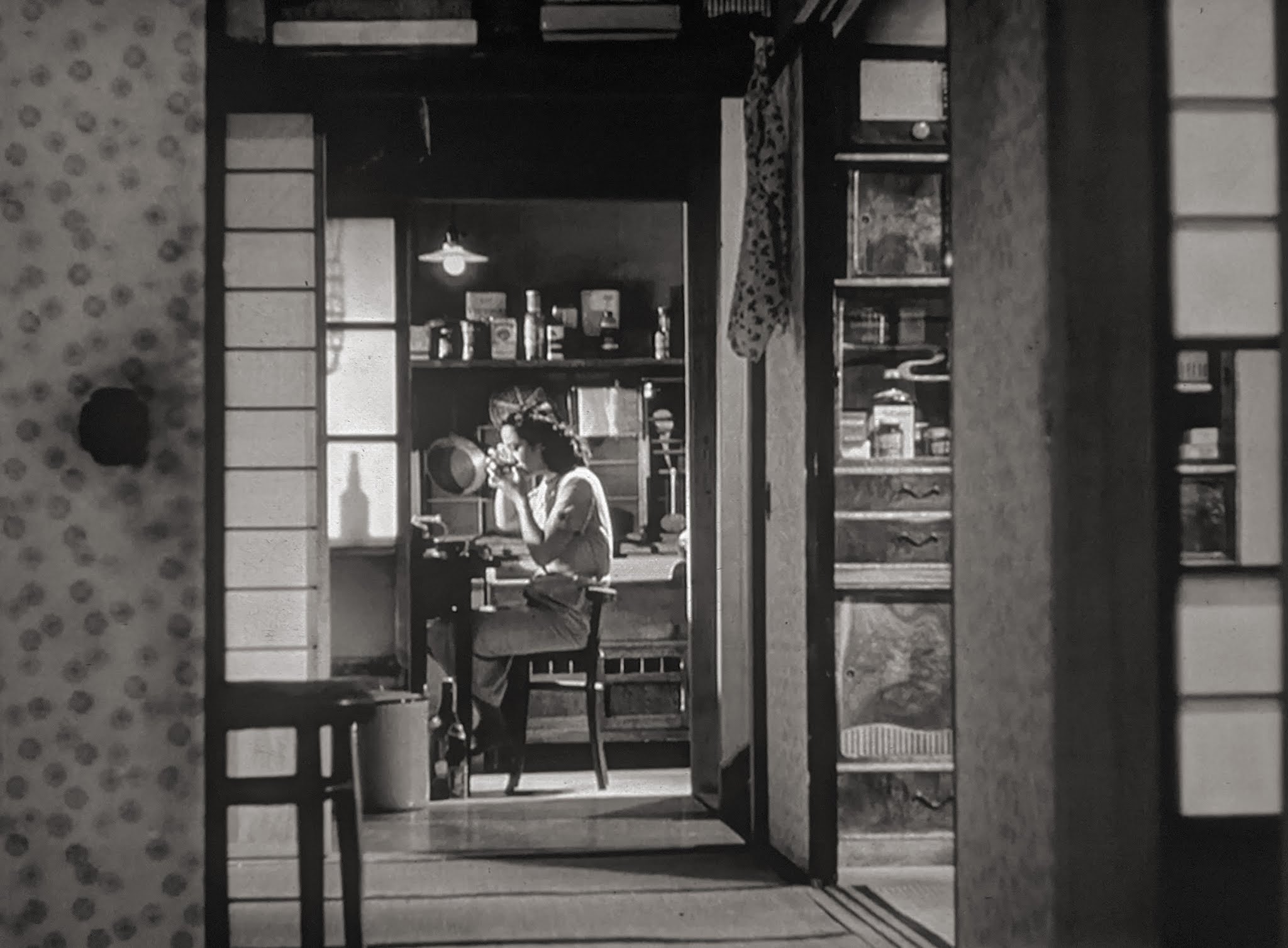
And below is a still from Early Summer: a trademark tatami shot. It's a multi-layered composition with an abundance of objects, but somehow Ozu still contrives to make it look elegant and minimalist. How does he do it?!

I'm glad I can enjoy these two very different movies, with their very different aesthetics.

Thursday, 30 July 2015

Dying Factory Owners

An Indian Supreme Court case involving water pollution caused by dyeing factories is often (mistakenly) cited in other judgments as "Tirupur Dying Factory Owners Association".

For me the typo always conjures up images of aged factory-owners, some on saline drips or life support systems, gathering weekly to talk about succession plans, business prospects, and their own approaching mortality.

Then I wonder, how close to death does a factory-owner need to be, in order to join this association? Which in turn reminds me of a scene from the movie Whatever Works:

Boris: I'm dying! I-I'm dying!
Jessica: Should I call an ambulance?
Boris: No, not now! No, not tonight, I mean eventually!

Thursday, 21 August 2014

Piranhas and the Ultra Left Dream

We got cable TV in 1998 when I was thirteen; until then I grew up watching two channels: DD1 and DD2.

I remember the first time I heard the Pink Floyd song Nobody Home, which had the line:
I got thirteen channels of shit on the TV to choose from
I was amazed that anyone had thirteen channels (shit or otherwise) to choose from. It seemed like some kind of paradise.

Every Saturday night, DD1, if my memory serves me right, used to broadcast an English movie. In pre-cable times, these movies, along with the VHS tapes my parents rented for us to watch during school vacations, were my only exposure to western cinema.

I have vivid memories of many of the DD1 English movies, but some left more of an impression than others. The Adventures of Robin Hood was screened in 1993, a few days before my brother Sujaan, who was three years old at the time, was due to start school. When the movie ended, he flatly announced that he would go to school without a fuss, but only if he was kitted out entirely in Lincoln green. After some bargaining our mother got him a green bag, and this was enough to keep him happy.

The night Robin Hood was to be telecast, we tuned in early to make sure we did not miss a single minute. The movie was announced by an on-screen message: Coming up: The Advantage of Robin Hood. I remember my father laughing at Doordarshan's typo.

I had a friend who also used to watch the DD1 English movies. In school on Monday we would discuss the movies in detail, and repeat lines which had made an impression on us. One such movie, The Phantom of Hollywood, had the line (in a threatening note slipped to a studio-chief) "To destroy the backlot is to destroy yourself."

We thought this had to be the greatest single line in cinematic history.

* * *

Last night I was reading some of Nabarun Bhattacharya's short stories. His (devastatingly good) short story ফ্যাতাড়ু (Fyataru) – about "an anarchic underclass fond of sabotage" who can fly with the aid of a secret mantra – has the following conversation:
—শনিবার টিভি-তে ইংরিজি সিনেমাটা দেখেছিলে?
—না তো।
—তা ভালো জিনিস দেখতে যাবে কেন? বইটা ছিল হেভি ভয়ের। এক পাল উড়ুক্কু মাছ! উড়ে উড়ে লোক ধরছে আর গলা কামড়ে মেরে ফেলছে।
—ভ্যামপায়ার।
—না, না। ভ্যামপায়ার তো হলো গিয়ে বাদুড়। এ হলো মাছ। একটা ডোবা জাহাজের খোলের মধ্যে থাকে। মাঝে মাঝে দল বেঁধে লোক মারতে বেরোয়ে।
Translation (with help from Sujaan):
—Did you catch the English movie on TV on Saturday?
—No?
—Of course, why would you watch the quality stuff? The movie was real scary. There was this swarm of fish which could fly. Flying at people, biting at their throats and killing them.
—Vampires!
— No, no. Vampires are what you call bats. These were fish. They lived in the hull of a sunken ship. From time to time they would emerge in hordes to kill humans.
The characters in the story are clearly referring to Piranha II: Flying Killers, a movie which I remember watching on DD1. ফ্যাতাড়ু was published in 1995, so it was almost certainly the very same telecast that I watched. On a Saturday night in the mid-nineties, in different parts of Calcutta, an excitable 10-year-old kid and a 47-year-old revolutionary writer at the peak of his powers were probably both watching the same corny American horror flick.

On a side note, director James Cameron jokingly described Piranha II as "the finest flying killer fish movie ever made" – a description which reminds me of a certain Durga Puja advertisement.

* * *

From the Times of India article about Nabarun Bhattacharya's demise, a line written without a trace of irony:
He sympathized with the ultra left dream of a society where "people will get enough to eat, their health will be looked after, and children educated."
On days when I think about my own (small) contribution to capitalist exploitation, it is good to know that in my own way, I too entertain ultra left dreams.

Tuesday, 15 December 2009

Tandemletter 0

Citizen Kane. Battleship Potemkin. Gone with the Wind. La Strada. It amazed him that so many people, in fact, it would be fair to say, most people, were unaware that the 1952 Celebration Pictures musical The Girl from Peking starring Jules Munshin as Joey Kay and Kitty Alexander as May-Ling Han was in fact the greatest movie ever made.
Alex-Li Tandem, protagonist of Zadie Smith’s wonderful, wonderful novel, The Autograph Man, is hopelessly besotted with forgotten forties movie actress Kitty Alexander. He rents but does not buy The Girl from Peking because he thinks that if he owned it, he literally would not do anything else but watch it. And from the age of fifteen, he has been sending her letters – fan letters and, at the same time autograph requests – and not one has ever been answered. For “Kitty Alexander signed even less than Garbo.”

One day, he realizes that the autograph guides had misled him with their advice that an Autograph Man should talk interestingly about himself, show that he is more than just a fan. He changes his strategy. He decides, instead, to tell her about herself.

He writes hundreds of these letters, and these are not answered either. But the letters are magic.

Dear Kitty,
When behind a young man on a bus, she finds herself staring at his neck. The urge to touch it is almost over-whelming! And then he scratches it, as if he knew.
Love,
Alex-Li Tandem
So, in a form of tribute/plagiarism on the lines of the My Hobby series, I have decided to write Tandemletters to celebrities living and dead, telling them about themselves. The first such post will be up as soon as I think of a suitable celebrity on whom to bestow the immense privilege of being the recipient of the first Tandemletter. Remind me if I forget, please? And yes, suggestions are welcome.

Saturday, 18 July 2009

In which attempts at humour run into a brick wall

Teaching Pratiti has three main advantages: (a) she is smarter than the average kid, so I need to put in less effort and can cover the ground faster; (b) in the garb of teaching Statistics I can get away with teaching maths (which is far more interesting); and (c) I get good food at her place. But sometimes I wonder if it’s all worth it. Because there are few things more dampening than to make clever comments before an unappreciative audience, and with Pratiti, this happens almost every week.

When I try to be funny, she usually quells me with a I-know-you’re-trying-in-your-silly-way-to-make-this-interesting-but-I-won’t-fall-for-it look. But more distressing is how so many of my clever comments are wasted on her because, being a kind of nerd, she often misses pop culture allusions which normal kids of her age ought to catch off the bat.

The other day I was explaining my preference for saying curves ‘hold water’ or ‘shed water’, rather than saying they are convex downwards or concave downwards. I said I find the terminology funny because it reminds me of Phoebe’s cute way of referring to G-sharp as ‘Ice Berg’ and A as ‘Bear Claw’ (because of her finger formations while playing them). But it turns out that she has never seen the Friends episode in question.

The week before, I was telling her about complex roots of cubic functions with real coefficients, and I quoted Yoda describing the Siths Lords’ Rule of Two: “Always two, there are. No more, no less.” Dashed clever of me, I thought it was. But it seems the misdirected girl has not seen a single Star Wars film!

Pratiti is one of those kids whose nerdy habits take them to the top of the class, but ever farther from normalcy. She has read the complete works of Dickens, but has never heard of I.R. Baboon. But I persevere: I will draw an approving giggle from her yet. Even if I have to quote Tolstoy in the next class.

Tuesday, 14 July 2009

A Tuesday Post

“In winter Hammerfest is a thirty-hour ride by bus from Oslo, though why anyone would want to go there in winter is a question worth considering.” So begins Neither Here Nor There, my second most favourite travel book in the world. Bill Bryson, fluent in at least one language, backpacks through Europe without a semblance of a plan. In Trouble Again: A Journey Between Orinoco and the Amazon hails from a similar but even more extreme school of travel writing – Redmond O’Hanlon travels uncharted rivers in a dugout canoe on a four-month journey to Venezuelan Amazonia to “party” with the Yanomami tribe, reputedly the most violent people on earth. “O’Hanlon’s approach to travel borders on the lunatic,” wrote a reviewer.

The polar opposite of this style of travel is the Conducted Tour. Since I have done most of my travelling with my parents who share my dislike for organized travel, I speak from limited experience. School excursions were, of necessity, conducted tours. So was a trip from Delhi to Agra with a busload of American law students, where tour guides first really started to get on my nerves. “Look to your left. Cowdung. All cowdung. Lots and lots of cowdung in India.” Tour guides hurry you all the time, reinforce stereotypes, mollycoddle you, force you into souvenir shops which give them kickbacks, and generally do their best to spoil your experience.

There are people who sign up for one-week conducted tours of South-East Asia, who “do” Europe in a fortnight. Nothing would induce me to spend that kind of money (assuming I had that kind of money) on such a trip, but I have to admit that the idea holds a strange fascination for me. Maybe this is because, deep in my guilty heart, I sometimes enjoy kitsch and the whole idea of naked consumerism. At 13,000 feet in the lap of breathtaking Himalayan scenery, I have been known to pine for Coke, and I would get a lawn flamingo for my room if only I knew where I could buy one.

That is why I thoroughly enjoyed If It’s Tuesday, This Must Be Belgium (though the fact that this is the first movie I watched since March might also have something to do with it). The film is a 1969 comedy which follows a colourful group of American tourists on a whirlwind conducted tour of Europe: “Nine countries in eighteen days. Four hundred and forty-eight dollars and fifty cents. No refunds.”

Which brings me to the topic of this post. Before I watched the film, I had a sort of idea that it features a snatch of dialogue like this:

“Where are we?” “I don’t know. What day is it?” “Tuesday.” “If it’s Tuesday, this must be Belgium.”

But it turns out there is no such passage in the movie. I am not sure about the day and the country, so maybe I heard or read it somewhere else. I am even beginning to wonder if I made it up in my head. If so, the phenomenon would be the opposite of cryptomnesia (I am sure they have a word for it). If anyone knows where the dialogue appears, please tell me. Extra credit to anyone who also tells me the opposite of cryptomnesia.

Wednesday, 6 May 2009

The Castafiore Emerald Post

My last ten posts, barring only two, have been about travel. I would much rather continue to write travel-posts, but unless Fortune unexpectedly smiles, I am now stuck at home until May 22, which is when I leave for Benares. So posts about Oriya delicacies, road trips, Buddhist caves, tribal festivals, side-lower berths and bright yellow birds will have to take a back seat for now.

As a break from the heady excitement of travel-writing, I thought of trying my hand at something I am not very good at: a contemplative post, a sit-at-home post, a post where nothing much happens. A Castafiore Emerald Post!

The Castafiore Emerald is the 21st book in the Tintin series. Before this, Tintin had been to all corners of the world - the U.S., Congo, Peru, Switzerland, Tibet and several imaginary countries. He had even gone on an undersea treasure hunt and an expedition to the moon. In The Castafiore Emerald, the adventure moved to Marlinspike.

On the cover, Tintin, acting for Hergé, puts his finger to his lips, inviting us to watch the comedy unfold. What follows is a meticulously constructed drawing-room farce, replete with red herrings, cross-connections and people falling down the stairs. To one who is not familiar with the Tintin series, it is hard to explain just how different The Castafiore Emerald is from the other Adventures. It has no exotic locales, no villain, no real danger - just a visiting opera diva and a valuable emerald gone missing. Almost no one likes The Castafiore Emerald.

Why then is it my favourite book in the Tintin series? I am not sure myself. Maybe it is because all the characters are so gloriously in their element; the book in some ways is nothing more than a series of scintillating character studies. Maybe it is because the story is so beautifully structured, so perfectly ordered, like a Jane Austen novel. Maybe it is because I have commonplace taste in general, but unconventional taste in the particular. Along with the rest of the world, I love the Beatles and Satyajit Ray, but my favourite Fab Four album is Rubber Soul, and my favourite Ray movie is Kanchenjunga.

The Castafiore Emerald also has one of the most beautiful panels Hergé ever produced: the night scene by the Roma camp fire on page 40. Tintin goes out for a stroll. It is a perfect night; haunting guitar music draws him to a clearing in the woods. And then he sees this.

I got this book when I was six years old. It would be many years before I learnt the word chiaroscuro, but that did not lessen my appreciation of this piece of art. Another panel which affected me profoundly on my first reading was this one.

I still remember the thrill of learning three new words from a single panel. For weeks afterwards, at the most trivial of incidents (e.g. power cut, bread getting burnt in the toaster), I would go “Cataclysm! Calamity! Catastrophe!”

I must have been a somewhat irritating kid.