Friday, 1 August 2014

The Milky Way over Lone Pine

In my blog CQA I wrote that one of the reasons I continue to blog is because through blogging, I've come to know some people I would not know otherwise. This summer I visited one such person in his desert lair at Lone Pine, California.

On the first night of our stay, the moon set early behind the Sierra Nevada. The skies were clear, and the remote desert location meant that there was minimal light pollution. When I ventured outside at around 2 am, I was treated to one of the most beautiful night skies I have ever seen.

The photograph I took captures only a small section of the vista that stretched out above us, but it has a number of interesting objects. The dominant feature is, of course, the Milky Way. You can also see (parts of) eight constellations, binary stars, a red supergiant whose diameter is nearly 900 times that of the Sun, and a number of deep-sky objects (star clusters, and nebulae – interstellar clouds of dust and gas hundreds of light years wide, where new stars are being born). The deep-sky objects have exotic names like the Wild Duck Cluster and the Eagle Nebula (and sometimes non-exotic names like NGC 6441). You can also see a star cluster 87,400 light years away in another galaxy, and a dark nebula in the shape of a black horse galloping through the heavens.

Perhaps coolest of all, the photo includes the galactic centre – the theorised location of a supermassive black hole known as Sagittarius A* whose mass is over 4 million times that of the Sun. Sagittarius A* cannot be seen in the photo – or even through astronomical instruments from Earth, at least not at visible wavelengths – because of interstellar extinction by dust and gas. We know its location because it is detectable as a source of strong radio waves.

You want to know where all these cool objects are, don't you? Click on the photo for an interactive guide.


I would have unveiled this photo long ago, but Anasua coaxed me into making the guide, which took weeks of research and coding. "Reach for the stars," she said.

Friday, 18 July 2014

Survival of the Fittest Onion

Onions are biennial plants. This is how they work:

Life Cycle of an Onion Plant
Year 1, Spring:Seeds germinate and start to grow.
Year 1, Summer:First the leaves sprout, then the bulb at the base of the plant begins to swell.
Year 1, Autumn:The bulb, where the plant stores food reserves for the winter, reaches maturity, but the foliage dries up and dies. This is when the onion bulb is usually harvested.
Year 1, Winter:If left undisturbed, the bulb lies dormant all through the cold months.
Year 2, Spring:Answering the call of the springtime sun, the bulb sends forth a shoot which initially feeds on the food stored in the bulb, then sprouts leaves which aid in photosynthesis.
Year 2, Summer:The stem "bolts" (begins to elongate rapidly) and produces a bud. The bud blooms into a flower, which eventually "goes to seed".
Year 2, Autumn:The plant dies, but next spring the seeds can grow into new plants.

Last spring I bought some onions from the supermarket and stored them in my kitchen cupboard. The cupboard is a dark, airless place, but even in such harsh conditions, life prevails. A few days later I discovered that one of the onions had begun to sprout.

Impressed by its will to live, I decided not to chop it up, and instead planted it in a pot.

The plant was undemanding – I just watered it every other day and fertilised it with coffee grounds. Still it grew steadily, putting forth leaves and in May, a pair of buds. But its tribulations were not yet over.

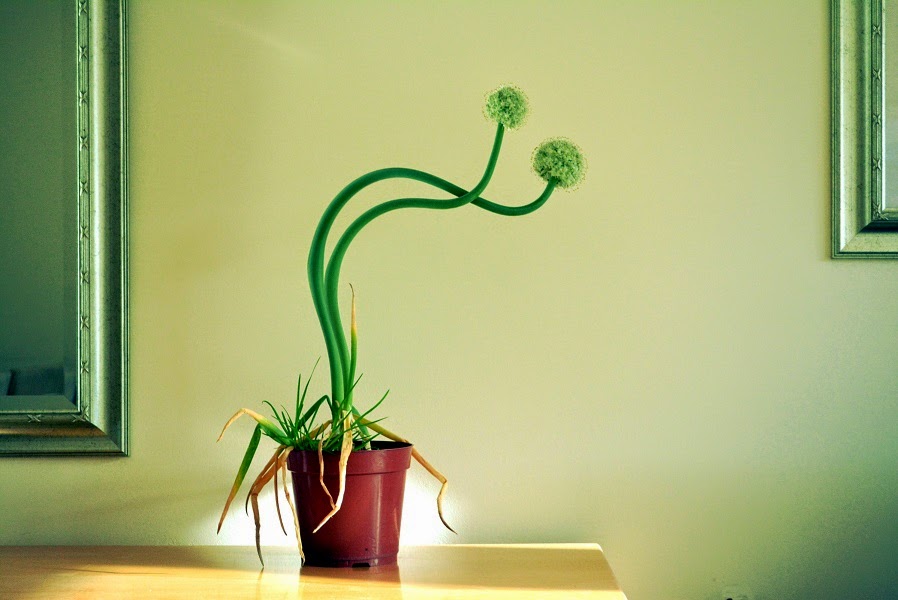
While I was on holiday in the USA, the pot was blown over by the wind. The plant lay ignominiously on its side, but undeterred by this misfortune, it bent upwards at a right angle and continued to grow. When I righted it, the stems – always reaching for the light – again bent upwards at a slightly higher point, giving the plant an interesting shape, a bit like a modernist sculpture. Here are some photos of the flowers in various stages of development.


At the time of writing, the flower petals are drying up. If the flowers have successfully self-pollinated, they may soon produce seeds. I think it's pretty cool that an onion bulb can flourish and reproduce even after being uprooted, sold in a supermarket and lying neglected in a kitchen cupboard.

Thursday, 3 July 2014

Lone Fox Dancing

I have previously posted about foxes in winter and foxes at night. In the interests of more well-rounded fox coverage, I now present a photo of a fox in summer, and in the daytime.


I took the photo inside our housing development, where red foxes have burrowed into the earth to make a den whose entrance is concealed by bushes.

The titles of my first two fox posts referenced a song (Fox in the Snow) and a book (The Foxes Come at Night). Last week at an outdoor cafĂ© in London I saw a notice which would have gone really well with the second post:


In case you were wondering, the title of the post you are reading now references a poem: a reader suggestion.

Monday, 30 June 2014

Flagging Demand


England car flags being sold for a discount at a supermarket in London, after England's first-round exit from the Football World Cup.

If I had any sense I would buy the lot, and sell them before Euro 2016 at a 700% profit.

Saturday, 21 June 2014

Seasons 2: Island Gardens, London

Move your cursor over the image below, and it should change to another image of the same scene in a different season. (If it doesn't work, check that your browser has JavaScript enabled.)


Base photo:31 May 2014
Mouseover photo:13 November 2011
Approx. coordinates:51.487°N, 0.008°W

One day in the autumn of 2011, I mentioned to my cousin that lots of people walk their dogs in my neighbourhood park. She likes dogs, so she asked for photos. The mouseover photo in this post is one of the few photos I took that day which does not have a dog in it. Summer is my favourite season in London, but there's no denying that the sugar maple trees in the park are at their best in autumn.

The base photo was taken last month, but I thought summer solstice is as good a day as any for a Seasons post.

Happy solstice, everyone!

Friday, 20 June 2014

The Roti Algorithm

Rotis (by which I mean the thin, circular rotis cooked without oil, called ruti in Bangla) are made by rolling atta (unleavened wholegrain wheat) dough into thin circular disks, which are then cooked over a dry tawa.

Cooking one roti at a time is inefficient because firstly, you waste time placing each roti on the tawa and then taking it off, and secondly, by the time the last roti is cooked, the first one is no longer warm. It is possible to cook several rotis on the tawa simultaneously, but to be properly cooked, each side of each roti must be in contact with the tawa for roughly the same period of time. Like most experienced roti-makers, my mother achieves this by flipping the rotis in a complex sequence. But when I asked her, she could not tell me what exact sequence she follows, because the technique, born of long experience, comes naturally to her.

So I gave some thought to the problem, and came up with an algorithm for cooking any number of rotis on the tawa at the same time, thus bringing advanced techniques within the grasp of even the most hapless roti-noob.

The algorithm is best illustrated by a flowchart:


A couple of definitions which are used in the flowchart or later in this post:
"Lowest Side" means the lower side of the bottom roti in the stack (i.e. the side in contact with the tawa).
"T" means the time taken to cook the Lowest Side, and is counted from the instant of completion of the most recent flip of all the rotis in the stack.

Some notes on the algorithm:
•As it is inconvenient to flip or remove rotis which are in the middle or bottom of the stack, I designed the algorithm so that (a) the flip operation only involves flipping either the top roti or the whole stack, and (b) once a roti cooked on both sides, the next action always brings it to the top of the stack whence it can easily be removed.
•On high heat, the Lowest Side gets cooked before it can conduct much heat to the roti above it. So while the Lowest Side is being cooked, the states of any rotis above the bottom roti are not significantly affected.
•To make multiple rotis at once, the dough has to be fairly dry so that the rotis in the stack do not stick to each other. If they're still sticky, it helps to spread a thin film of dry atta on each roti.
•It is rarely necessary and never practical to cook more than 5-6 rotis at a time, because the time thereby saved is offset by the difficulty of flipping several rotis at once. But the algorithm works for any number of rotis.

The algorithm is actually easier to master than the flowchart might suggest. Once you get the hang of it, the next step is obvious even without referring to the flowchart.

To give you an idea of how the algorithm works, I made a short animated video (0:36) for 6 rotis. Each side of each roti is represented by a black rectangle, which turns red when it is cooked. T in the video is 1.5 seconds, which is shorter than the actual time it takes to cook one side of a roti in real life.

Friday, 13 June 2014

Atheism and the En Dash

There was an odd article in the Guardian today which argued that "there are no atheist babies". Specifically, the author took issue with a Richard Dawkins quote: "When you say X is the fastest growing religion, all you mean is that X people have babies at the fastest rate. But babies have no religion."

'Atheism' can mean either a rejection of the existence of deities (explicit atheism) or, more inclusively, an absence of belief in the existence of deities (implicit atheism). The article is odd because it argues that babies are not explicitly atheist, while Dawkins was only saying that babies are implicitly atheist.

But my main quibble with the article is the paragraph below:


Not one but two consecutive lines begin with an en dash. I really think that a self-respecting newspaper should precede a parenthetical en dash with a non-breaking space so that a line can end – but never begin – with an en dash. In HTML, it is coded as  – followed by an ordinary space.

In some of my old posts you might come across a spaced en dash not preceded by a non-breaking space, but there is an explanation for that. Anyway, I must not get complacent; I learn new things all the time. In a recent post I wanted to use double quotes followed by a left parenthesis, and I realised that some browsers might insert a soft return between the two punctuation marks. In case the information is of use to anyone, I got around it by coding the text thus: <nobr>"(S)he</nobr> did it!"


Edit: I have just learnt from Tommy that <nobr> has been deemed a non-standard element, but the same effect can be achieved with CSS:
<span style="white-space:nowrap;">"(S)he</span> did it!"
Like I said, I learn new things all the time.

Wednesday, 11 June 2014

Bellingham, 12:53 pm


On the drive down from Mount Baker, I saw a good example of a 22Âş halo, an optical phenomenon caused by the refraction of sunlight by hexagonal ice crystals in a layer of cirrostratus nebulosus cloud. The inner edge of the halo is red and the outer edge bluish, though this could be seen more clearly with the naked eye than in the photo.

The 22Âş halo is actually a fairly common phenomenon, occurring up to 100 days a year in temperate latitudes. If you haven't seen it, it's probably because you are wise enough not to stare at the sun.